The Middle of Your Rope Journey
What No One Tells You About the Middle of Your Rope Journey
There is a lot of attention given to the beginning of rope.
Beginners are welcomed, guided, reassured. Their questions are expected. Their uncertainty is normalized. There is excitement, novelty, and encouragement built into every interaction.
There is also admiration for people who have been doing rope for a long time. Advanced players are recognized for their skill, their confidence, their depth. They are seen as people who “know what they’re doing.”
But almost no one talks about the space in between.
The middle of a rope journey is quieter. It can feel confusing. And for many people, it’s the point where doubt creeps in for the first time.

Athraell tied by Natalie Rose, at the end of a session.
The middle is where confidence wobbles
Early on, progress feels obvious. You learn something new, try it, and feel the difference immediately. You collect vocabulary, experiences, and small wins.
Then, at some point, that forward motion slows.
You’ve learned enough to know what you don’t know. You start noticing nuance. You become more aware of your body, your partner, and the complexity of scenes. Things that once felt exciting now feel layered, demanding, or uncertain.
This is often when people quietly wonder if they’re doing it wrong.
For people being tied, this can show up as questioning your reactions. You notice that your responses vary from scene to scene. One day you feel open and connected. Another day you feel distracted, heavy, or flat. You may wonder if you’re supposed to respond a certain way, or if your body is failing to cooperate.
For people tying, the doubt often looks different. You might feel pressure to use everything you’ve learned, all the time. You start questioning whether your scenes are “enough.” You compare your pacing, creativity, or confidence to others and wonder if you’ve stalled.
Both experiences come from the same place: increased awareness without clear landmarks.
Comparison gets louder in the middle
The middle is where comparison sneaks in, even for people who thought they were immune to it.
You notice how other people talk about rope. You see photos, performances, class descriptions, and online conversations. You start measuring your internal experience against someone else’s external presentation.
For bottoms, this might look like wondering why you don’t float the way others do, or why certain sensations don’t land the same way. You might feel self-conscious about needing adjustments or asking questions you thought you were “past.”
For tops, comparison can turn into pressure. You might feel like you should be progressing faster, tying harder, going deeper, or doing something more impressive. You may worry that repeating familiar material means you aren’t growing.
The middle is where rope stops being about novelty and starts asking for patience.

Natalie Rose in a suspension, tied by Conroy
Uncertainty is not failure
One of the hardest parts of the middle is not knowing what to practice next.
You’re no longer just learning basics. You’re also not refining a single advanced style yet. You’re experimenting, repeating, adjusting, and paying closer attention. That work is subtle. It doesn’t always feel rewarding at the moment.
But uncertainty here is not a sign that something is wrong. It’s a sign that you’re integrating.
For people being tied, this is often when body awareness deepens. You start noticing early signals. You recognize the difference between discomfort that passes and sensation that needs attention. Your communication becomes more specific, even if it feels less dramatic.
For people tying, this is often when listening becomes the real skill. You learn that good scenes are not built by stacking techniques, but by responding to what is actually happening in front of you. Growth becomes quieter and more relational.
This stage asks you to slow down, not speed up.
The middle is where rope becomes personal
Eventually, something shifts.
You stop trying to perform rope correctly and start practicing it honestly. You learn what works for you, with your body, your timing, and your relationships. You become less interested in proving progress and more interested in understanding experience.
The middle is where rope stops being something you do and starts becoming something you live with.
It’s not flashy. It’s not linear. And it doesn’t always come with reassurance from the outside.
But it’s where depth is built.
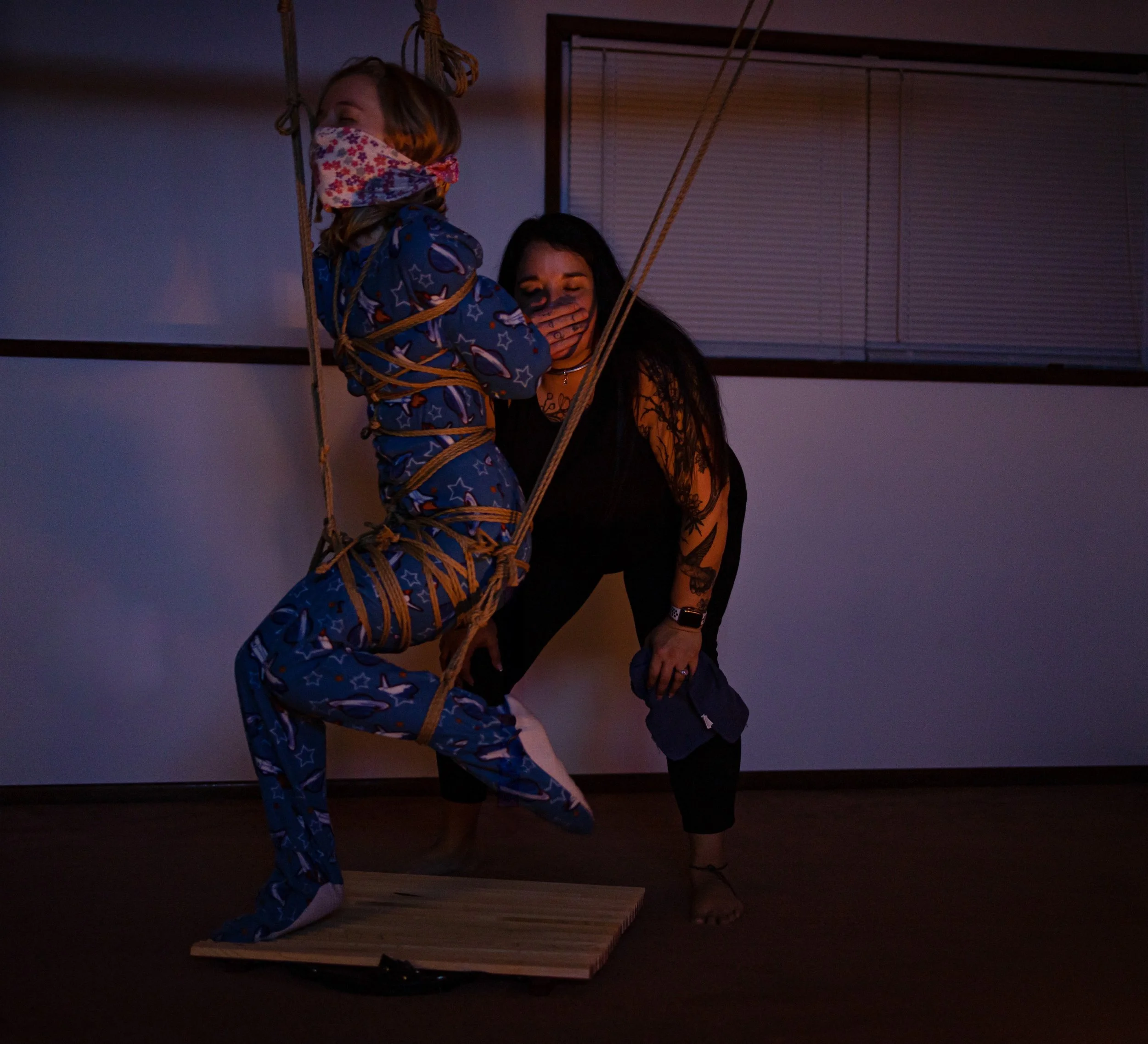
Chuck tied by Natalie Rose. Nat has taken their hat off and has placed their face in Chuck’s hand to check-in and connect.
If you’re here, you’re not behind
If your rope journey feels quiet, uncertain, or less exciting than it once did, you’re not failing. You’re not stuck. You’re not doing it wrong.
You’re in the middle.
And the middle is where skill becomes embodied, communication becomes natural, and practice becomes sustainable.
It’s where rope stops being about accumulation and starts being about understanding.
If this resonates, you’re exactly where many people are — even if no one talks about it out loud.
Staying in the middle
Many people leave rope here.
Not because they lack care or curiosity, but because the middle doesn’t come with applause. There are fewer clear markers of success. Fewer moments where someone tells you that you’re doing it right.
Staying requires a different kind of commitment.
It asks you to keep showing up when things feel ordinary. To practice listening instead of collecting. To repeat scenes, positions, and conversations not because they are impressive, but because they teach you something new each time.
For some, staying means seeking out education that meets you where you are now, not where you started. For others, it means slowing down, asking better questions, or giving yourself permission to rest without calling it stagnation.
The middle isn’t something to push through.
It’s something to learn how to live inside.
And the people who do often discover that this is where rope stops being about proving skill and starts becoming a language they can speak with honesty, trust, and care.
Until next time...
Take a deep breath.
Unclench your jaw.
Tie. Untie. Retie.
You've got this.