What Actually Makes Rope Feel Good?
What Actually Makes Rope Feel Good?
There is a quiet question that lives underneath many rope experiences, even when no one says it out loud:
Why did that feel so good? Not just physically. But emotionally. Psychologically. Viscerally.
Why did one scene stay with you for days while another, technically correct and visually beautiful, faded almost immediately?
It is easy to assume that good rope comes from advanced skill, complicated ties, or dramatic positions. But the experiences people remember most are rarely defined by complexity. More often, they are shaped by something less visible and far more intentional.
Rope doesn’t feel good by accident. There is something else worth saying plainly. Good rope is not created by talent alone. It is created by attention.
It asks the person tying to stay present instead of performative. It asks the person being tied to stay connected instead of disappearing. When either person is distracted, rushing, proving something, or chasing an outcome, the body can feel it immediately.
Rope has very little tolerance for pretense. You cannot fake presence with another nervous system pressed so close to your own. The body reads what is real long before the mind explains it.
When rope feels deeply good, it is often because both people have made the quiet decision to arrive fully and remain there. It feels good when the nervous system is able to settle inside the experience. And that is something both people create together.
Good rope is built on pacing
One of the most overlooked elements of rope is speed. When rope moves too quickly, the body does not have time to orient. Sensation arrives before the nervous system can process it. Even if the tie itself is skillful, the experience can feel abrupt or hard to inhabit.
Pacing is what allows someone to arrive fully in their body. A moment to feel the rope make contact. A moment to notice the pressure. A moment to breathe before the next transition. Slowness is not about theatrical control. It is about physiological permission. The body relaxes when it can track what is happening.
This is true whether you are the person tying or the person being tied.
Good rope often feels unhurried even when intensity builds.
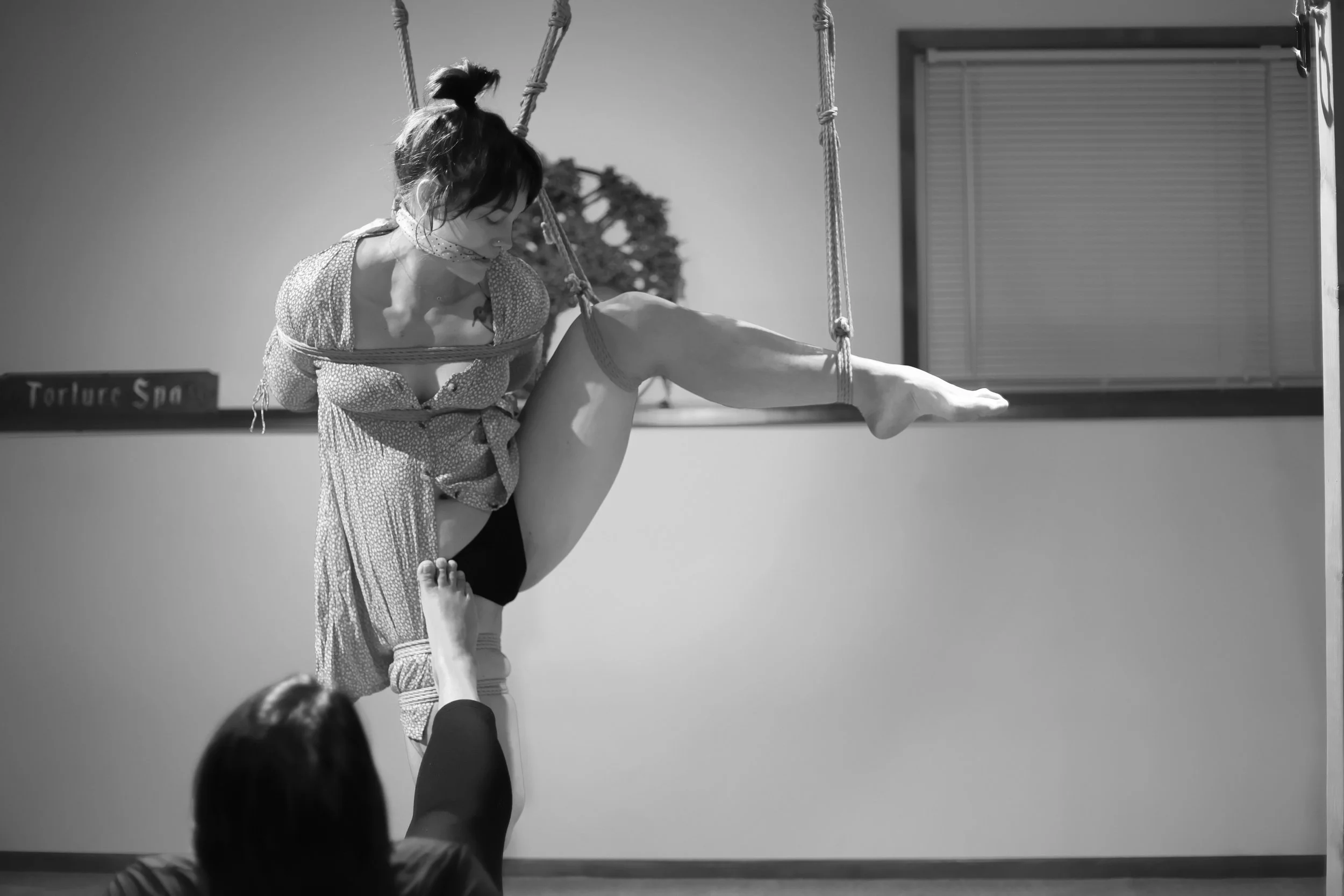
Natalie Rose taking a moment to appreciate Rion Riot in suspension
Predictability creates safety and safety allows sensation
There is a common misconception that unpredictability makes rope more exciting. And sometimes it can.
But what many nervous systems respond to first is coherence. When movements are deliberate rather than chaotic, when touch is intentional rather than scattered, the body stops bracing for impact. Energy that would have gone toward vigilance becomes available for sensation instead. This is where depth begins.
Predictability does not mean boredom. It means the experience makes sense while it is happening. Surprise has more room to land when the foundation feels steady.
Tension is a language
Long before a word is spoken, rope communicates through pressure. Firmness can feel containing. Steady tension can feel supportive. Inconsistent tension can feel distracting or unsettling.
Many people underestimate how profoundly the body responds to this conversation.
The nervous system is constantly asking:
Am I being considered?
Are they doing rope WITH me?
Or are they doing rope TO me?
When tension is applied with care, the body often answers by softening. When it is erratic, the body tends to guard itself sometimes without the person fully realizing why. This is not about perfection. It is about attentiveness.
Hands learn this language over time. So does the body receiving it.
Emotional tone shapes the entire experience
Every rope scene carries an emotional atmosphere, whether it is named or not. Focused. Playful. Quiet. Intense. Reverent. Curious. People often remember the tone long after they forget the structure of the tie.
You can place someone into a technically identical position twice and create two completely different experiences depending on the emotional field surrounding it.
Tone is shaped by small things:
Eye contact.
Breath.
Presence.
The absence of hurry.
The quality of attention.
When someone feels genuinely attended to, not performed at and not rushed through, the experience tends to register as meaningful rather than mechanical. This is true for both sides of the rope. Being deeply focused on another person changes the quality of the moment for everyone involved.
Transitions are where trust becomes visible
Often, the moments people remember most are not the ties themselves, but the transitions between them.
The lift.
The lowering.
The tightening.
The release.
Transitions ask the body to reorganize quickly. They are moments when awareness heightens and vulnerability can increase.
When transitions are handled with steadiness, the body learns something important:
I am being moved, but I am not being lost.
Trust grows rapidly in these spaces. Rushed transitions tend to linger in memory for the opposite reason.
It is not the complexity of rope that builds trust, it is the care within movement.
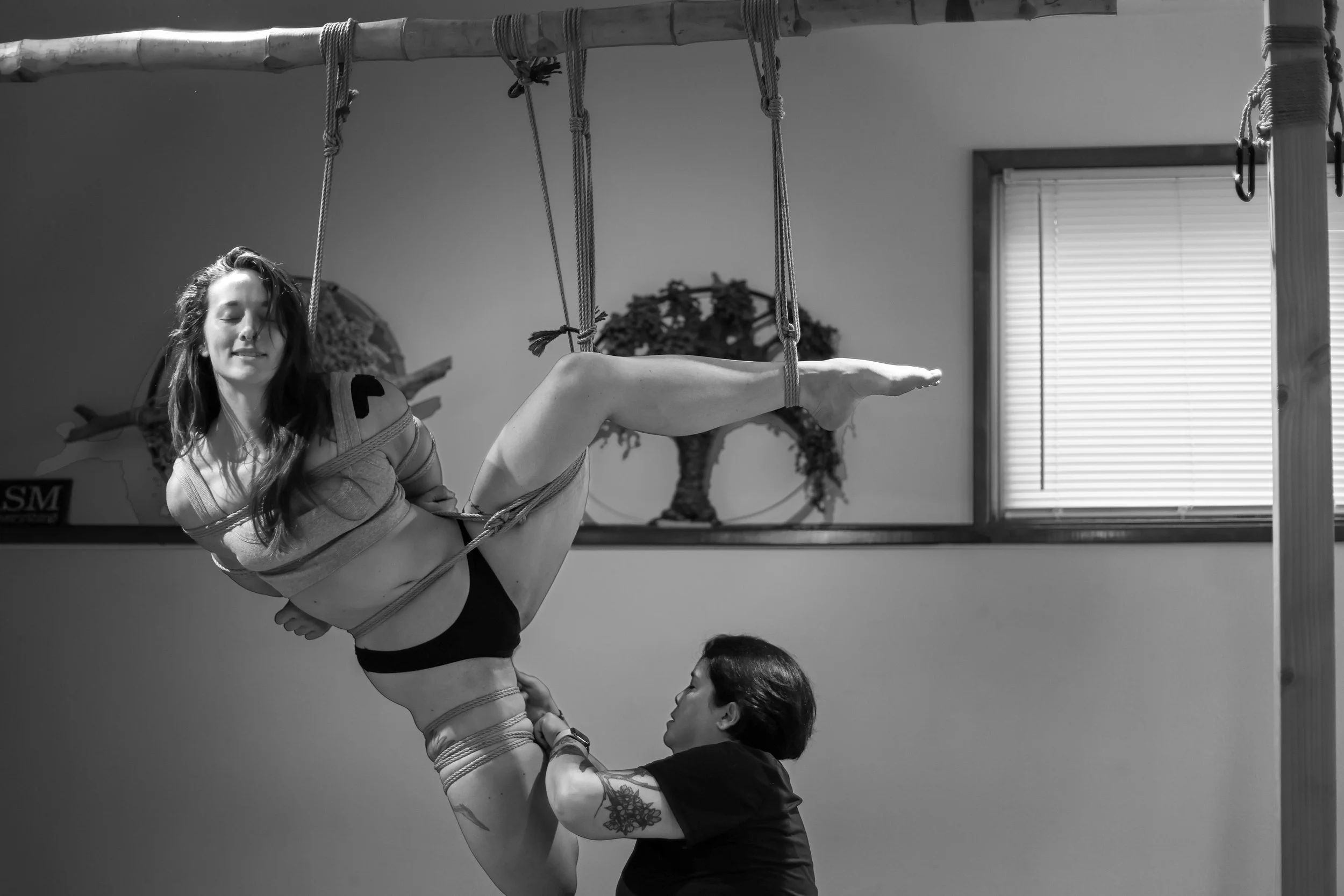
Rion Riot being transitioned from a partial to a full suspension with Natalie Rose
Feeling good is not the same as looking impressive
Some of the most visually striking rope does not feel particularly good to inhabit. And some of the most powerful experiences would appear almost ordinary from the outside.
Spectacle and sensation are not the same currency.
When people begin letting go of the idea that rope must look advanced to be meaningful, something opens. Attention shifts toward responsiveness instead of performance. Toward listening instead of executing. Toward experience instead of appearance. And often, that is where rope becomes most compelling.
The body remembers coherence
After a scene, people may not recall every detail. But the body keeps an imprint of how the experience was organized.
Whether it felt rushed or spacious.
Fragmented or cohesive.
Mechanical or attentive.
When rope feels good, it is often because the experience had an internal logic the body could follow. One moment led into the next without forcing adaptation faster than the nervous system could manage. Coherence is calming. And a calm nervous system can feel far more.
Good rope is a shared construction
It is tempting to assume that creating a good experience is primarily the responsibility of the person tying. But rope is always relational. The person being tied contributes through communication, responsiveness, breath, and the willingness to remain present in their body.
Neither role is passive. Both are participating in the same unfolding conversation. When this becomes mutual when attention moves in both directions rope often stops feeling like something being done and starts feeling like something being created.
Together.
When rope starts to feel deeply good
Over time, many people notice a shift. They stop chasing positions. Stop equating difficulty with value. Stop assuming more rope equals more depth. Instead, they begin recognizing the elements that allow the body to settle and the mind to open. The experience becomes less about achieving something and more about inhabiting it.
There is a quiet maturity that develops in rope over time.
People stop asking, “Was that impressive?”
And begin asking, “Was that honest?”
Because honesty is what the body trusts. Not how complex the tie was. Not how long someone endured. Not how striking it may have looked from across the room. But whether the experience was built with enough care that both people could remain inside it without abandoning themselves.
Good rope is not measured by spectacle. It is measured by how safely two nervous systems were able to meet. And when that happens, people rarely need to ask why it felt good. Their body already knows.
Good rope does not always announce itself dramatically. Sometimes it shows up as a quiet sense that you were able to be fully there. Aware. Connected. Undistracted. And that is what people tend to return for not just the rope itself, but the quality of presence it made possible.
Until next time...
Take a deep breath.
Unclench your jaw.
Tie. Untie. Retie.
You've got this.